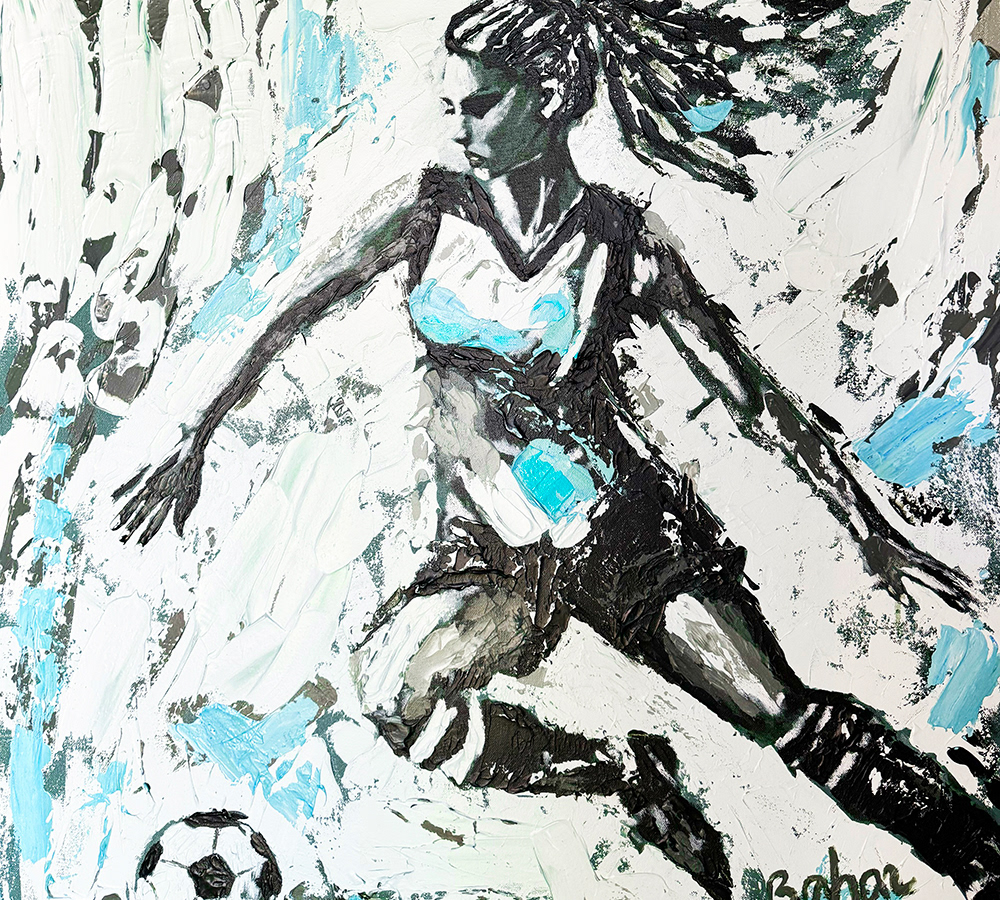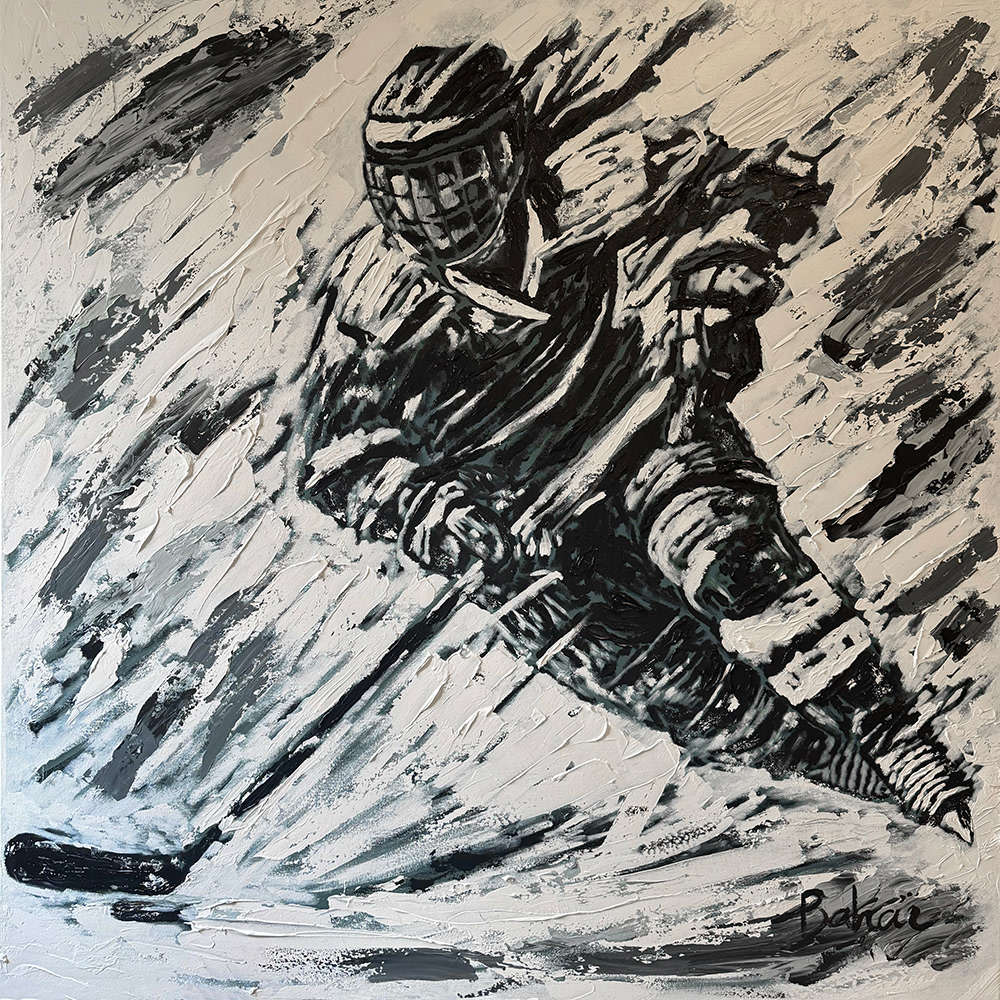
The Hockey Player ORIGINAL Hand-Painted Acrylic Art on Canvas by the Author
A Reflection
The purpose of this journal is a personal reflection on junior team sport development through the theoretical lens of Robert Bosnak’s Embodied Imagination (EI) framework, as observed in his video presentation on dreamwork and alchemy. Watching Robert Bosnak speak about EI, the method he pioneered in the late 1970s, drawing on Jungian psychology, alchemy, phenomenology, and neuroscience, was an unexpectedly compelling experience for someone reflecting through the lens of junior team sport development (Bosnak, 2022a, 2022b).
At first consideration, a therapeutic dreamwork practice may seem distant from the noise and physicality of a youth-sport training ground. Yet as Bosnak spoke, articulating how humans begin to carry multiple simultaneous body states and how transformation emerges not from forced interpretation but from slow, attentive, embodied presence, the parallels became difficult to dismiss. Junior sport, particularly team sports such as ice hockey, is a lived, bodily, and relational experience in which young athletes constantly navigate multiple perspectives, unexpected group dynamics, and moments of individual and collective transformation.
One of the most striking observations from the Bosnak videos was his insistence that the body is not merely a vehicle for psychological processes; it is the primary site where experience is registered, held, and transformed (Bosnak, 2022a). In EI, when a dreamer re-enters a dream image, they do not analyze it intellectually; rather, they notice where sensations arise in the body and attend to those anchor points as the real locus of meaning and change. Watching Bosnak describe this process, I immediately thought of young ice hockey players. Research confirms that young sport participation generates rich somatic experiences. The psychological arousal of competition, the felt sense of cohesion with teammates, and the bodily registers of shame, pride, fear, and belonging shape development at both individual and group levels (Acharki et al., 2025). Yet conventional coaching discourse typically privileges verbal instruction, technical correction, and outcome-oriented feedback, leaving little room for attending to what young athletes are experiencing in their bodies at any given moment (Gearity & Kuklick, 2022).
Bosnak’s framework prompted me to consider how differently junior ice hockey development might unfold if coaches were trained to notice and respond to the embodied, sensory states of their athletes, not as distractions from performance, but as the very medium through which development occurs. The observation aligns with Acharki et al.’s (2025) finding that facilitative coaching practices in youth hockey are most effective when they engage athletes’ psychological and embodied experiences, rather than focusing exclusively on technical or tactical instructions. Young athletes derive their deepest development gains from sport when they feel deeply from their imaginative success through embodied imagination (Bosnak, 2022b).
A second key concept in Bosnak’s video that resonated strongly with junior team-sport dynamics was the notion of the transit, the imagination’s absorption into the perspective of a dream image that is not oneself (Bosnak, 2022a). In EI practice, the dreamer is guided to embody the perspective of an object figure that feels alien or challenging, discovering through that imaginative inhabitation new possibilities not available from one’s habitual point of view. This is where the most profound change occurs. Junior hockey players continuously inhibit multiple perspectives, their own, their teammates, their opponents, and the collective. Battaglia and Kerr (2024) found that junior hockey players reported significantly richer developmental experiences compared to individual sports: the center player who must imaginatively absorb the movement patterns of a forward player, the defenseman who must inhibit the spatial logic of the opposition’s attack, the bench player who must hold the team’s collective effort in their body even while not on the ice.
In the videos, Bosnak described alchemy not as a primitive proto-chemistry, but as a sophisticated metaphorical language for the transformation of raw elements through a slow, attentive process within a containing vessel, the crucible (Bosnak, 2022a). For the alchemists, primal matter was understood to consist of living, creative forces; the practitioner's work was not to impose change but to create conditions under which transformation could emerge. The body itself functions as the crucible, holding multiple conflicting anchor points, multiple simultaneous body states, until a new, more complex pattern emerges that was not predictable from any single element. Transformational leadership by hockey coaches has consistently been identified as a key variable in creating the conditions for junior hockey players to develop personal and social skills that transfer beyond sport (Erikstand et al., 2021; Lefebvre et al., 2023).
Conclusion
Engaging with Robert Bosnak’s Embodied Imagination framework through his video presentation promoted a genuinely unexpected reconsideration of what junior team sport, such as hockey, involves at its deepest level. The framework’s insistence on embodied presence over intellectual analysis, on patient attention to the “other” over interpretative imposition, and on understanding transformation as an alchemical process that cannot be forced but only facilitated.
Youth athletes such as junior hockey players navigate a complex imaginal space in which multiple bodies, perspectives, and possibilities are in dynamic interaction. Coaches who can attend to that complexity with the kind of slow, embodied, non-interpretive presence that Bosnak models find that the development they facilitate runs deeper than any drill or debrief alone could produce. The power of embodied imagination is the primary step towards mental rehearsal, or guided visualization, a step-by-step visual movement before the actual event.
References
Acharki, E. R., Spaaij, R., & Nieuwelink, H. (2025). Facilitative coaching practices for youth developmental outcomes in sport. International Review for the Sociology of Sport. https://doi.org/10.1177/10126902251345689
Battaglia, A., & Kerr, G. (2024). Youth athletes' perspectives on developmental influences of relationships in individual and team sports. Cogent Social Sciences, 10(1), Article 2392023. https://doi.org/10.1080/23311886.2024.2392023
Bosnak, R. (2022a). Alchemy and psychology with Robert Bosnak [Video]. YouTube. https://www.youtube.com/watch?v=Nx7ro7tDMtw
Bosnak, R. (2022b). Dreaming and embodied imagination with Robert Bosnak [Video]. YouTube. https://www.youtube.com/watch?v=sMXWEYnUTYo
Erikstad, M. K., Høigaard, R., Côté, J., Turnnidge, J., & Haugen, T. (2021). An examination of the relationship between coaches' transformational leadership and athletes' personal and group characteristics in elite youth soccer. Frontiers in Psychology, 12, Article 707669. https://doi.org/10.3389/fpsyg.2021.707669
Gearity, B., & Kuklick, C. (2022). Learning to coach children in sport. In S. Pill & B. SueSee (Eds.), Coaching pedagogy (pp. 213–228). Routledge. https://doi.org/10.4324/9781003199359-51
Lefebvre, J. S., Kelly, A. L., Côté, J., & Turnnidge, J. (2023). Transformational coaching. In A. L. Kelly (Ed.), Talent identification and development in youth sport (pp. 163–179). Routledge. https://doi.org/10.4324/9781032232799-13