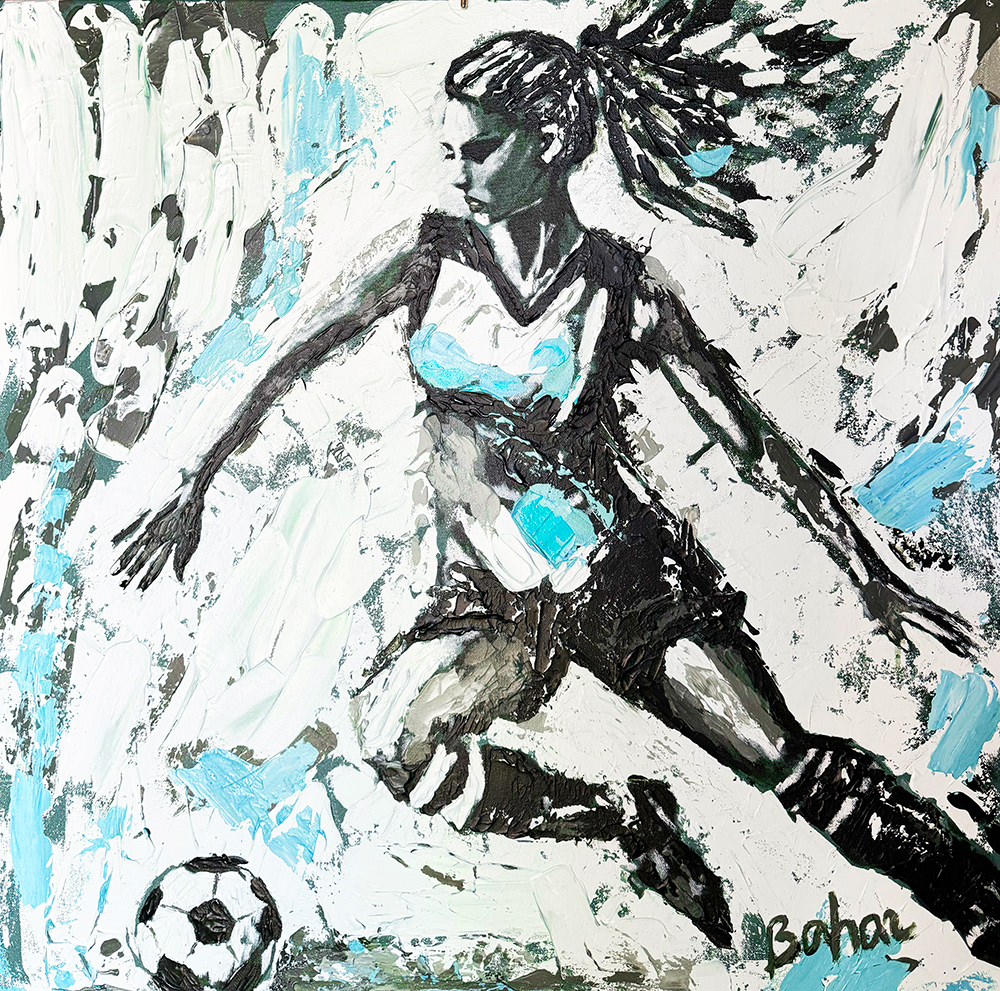
The Soccer Player ORIGINAL Hand-Painted Acrylic Art on Canvas by the Author
Watch this Video
Bosnak's video opened up something I keep returning to: the idea that transformation doesn’t happen through analysis alone, but through sustained, lived, bodily experience.
Schiavio and colleagues published “Optimizing Performance Skills in Social Interaction: Insights from Embodied Cognition, Music Education and Sport Psychology” in Frontiers in Psychology. What struck me about this piece is how it repositions the idea of skill as something genuinely distributed across a team through shared bodily experience. The authors describe what they call “distributed bodily memory”, where past experience of interacting with teammates becomes encoded not just cognitively but somatically, shaping how players intuitively respond in future game situations. They also explored the “feeling of being together,” a real-time, sensory attunement between teammates that enables fluid coordination without explicit verbal communication.
Soccer players, rowers, and synchronized swimmers, in their examples, don’t think their way into coordination; they feel their way there.
My second source, Zahno and Hossner’s systematic review “On the Issue of Developing Creative Players in Team Sports”, takes a phenomenological angle on athletic creativity. Rather than treating creativity as a purely cognitive ability or as something generated in the head before execution, the authors challenge this view directly. Drawing on Campos, they describe creativity in sport as “in-the-moment” and fully embodied: the athlete is understood as a “bodymind that moves and thinks in a continuous act”. Imagination, in this framework, is not visualization alone; it is the felt sense of what is POSSIBLE. As they put it, actions “must not only be visualized but must be felt to be possible. That is the direct echo of Bosnak.
In team sports, a player who has developed what EI calls “slow observation”, the capacity to remain present with somatic impressions before reacting, is more likely to perceive the “feeling of being together” that Schiavio and colleagues describe as a hallmark of collective expertise. EI’s emphasis on multiplicity of consciousness also maps well onto team dynamics: a midfielder holding awareness of multiple positional perspectives simultaneously is, in real sense, practicing what Bosnak describes as inhibiting multiple psychological states at once.
One legitimate critique is that EI’s clinical origins make it difficult to scale into competitive athletic environments, where time pressure and physical intensity dominate. However, Zahno and Hossner’s work suggests that the distinction between thinking and doing in sport may be less sharp than we assume, which is precisely the opening EI needs. If imagination in sport must be felt to be useful, then practices that cultivate felt bodily awareness are not soft additions to athletic training; they may be foundational to it.
References
Schiavio, A., Gesbert, V., Reybrouck, M., Hauw, D., & Parncutt, R. (2019). Optimizing performative skills in social interaction: Insights from embodied cognition, music education, and sport psychology. Frontiers in Psychology, 10, 1542. https://doi.org/10.3389/fpsyg.2019.01542
Zahno, S., & Hossner, E.-J. (2020). On the Issue of Developing Creative Players in Team Sports: A Systematic Review and Critique From a Functional Perspective. Frontiers in Psychology, 11, 57547. https://doi.org/10.3389/fpsyg.2020.575475